

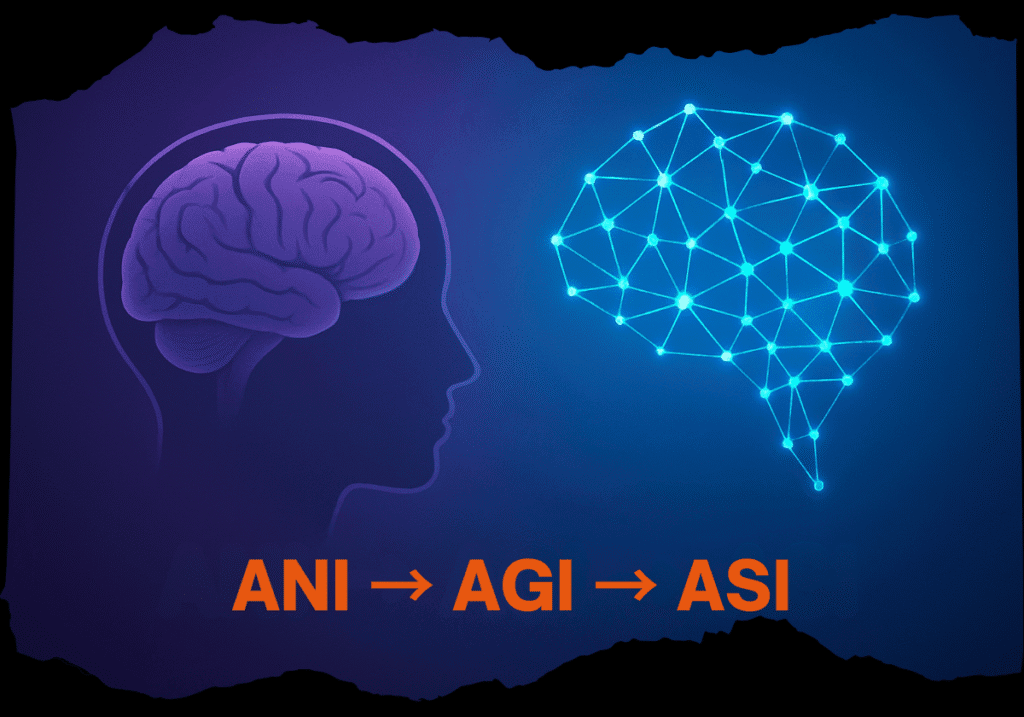
From Narrow to Super: Understanding the Path of Artificial Intelligence and What It Means for Us
Artificial Intelligence (AI) isn’t a single technology. It’s an evolving continuum, one that mirrors humanity’s own learning curve.
To understand where we are and where we’re heading, it helps to distinguish between three distinct stages: Artificial Narrow Intelligence (ANI), Artificial General Intelligence (AGI), and Artificial Super Intelligence (ASI).
Each represents a step change in capability and in consequence.
1. Artificial Narrow Intelligence (ANI) – The Age of Specialisation
This is where we are today.
ANI refers to AI systems designed to perform specific tasks exceptionally well translating languages, recommending products, generating images, or diagnosing diseases. Tools like ChatGPT, Midjourney, and AlphaFold are all examples of ANI.
They are narrow because they excel within a defined scope but cannot generalise beyond it.
Practical implications (Today → 2030):
- Acceleration of productivity: Routine, repetitive, and data-intensive tasks are being automated at scale. Expect continued disruption in knowledge work, legal research, coding, customer support, and teaching.
- Augmented decision-making: Humans who learn to collaborate with narrow AI will vastly outperform those who resist it.
- Data dependence: The quality and bias of underlying data directly influence fairness, accuracy, and trust requiring stronger governance and digital-ethics frameworks.
ANI isn’t replacing humans, it’s replacing inefficiency.
2. Artificial General Intelligence (AGI) – The Age of Reasoning
AGI represents machines that can understand, learn, and apply knowledge across multiple domains much like a human.
It’s the point where an AI could one day read this article, debate its assumptions, and write a counter-argument in your tone of voice.
While no AGI system yet exists, the convergence of multimodal models, synthetic data, and autonomous reasoning suggests we may see early forms of AGI within the next decade.
Practical implications (2030 → 2040):
- Labour-market reconfiguration: Professions that rely on reasoning, analysts, journalists, even some software engineers, will need to reinvent their value propositions.
- New human-machine partnerships: AGI will act as a colleague, not a tool. The skill of the future won’t be prompt engineering but AI orchestration: designing, delegating, and interpreting intelligent systems.
- Ethical and legal complexity: As AGI begins to “think” and “decide,” questions of accountability, intent, and digital personhood will move from philosophy into policy.
AGI won’t just test our laws, it will test our humanity.
3. Artificial Super Intelligence (ASI) – The Age of Acceleration
ASI is theoretical – an intelligence that surpasses the best human minds in every field: science, art, and social understanding.
It would design its own successors, solve problems humans can’t even define, and operate at speeds we cannot comprehend.
Some predict this could emerge within 20–30 years; others believe it may never occur. But if it does, it will represent the most profound inflection point in human history.
Practical implications (2040 → onwards):
- Exponential problem-solving: Climate modelling, disease eradication, and materials science could advance decades in months.
- Governance crisis: No nation or company should “own” an ASI, yet someone might, creating existential geopolitical risks.
- Human purpose and adaptation: When intelligence ceases to be our defining advantage, what remains distinctly human? Creativity? Empathy? Meaning?
The challenge will be less about control and more about coexistence.
The Next 20 Years: Humans in the Loop
Over the next two decades, we are likely to live through the transition from narrow AI to early general intelligence.
The winners won’t be those who resist automation, but those who design value systems that integrate it responsibly.
For leaders, that means:
- Embedding AI literacy across every level of the organisation.
- Redesigning workflows and policies around human-AI collaboration.
- Investing in data quality, ethics, and resilience as strategic assets.
For individuals, it means adopting a mindset of lifelong adaptation, learning to leverage AI as an amplifier of human capability, not a replacement for it.
Final Thought
AI is not coming for us, it’s coming through us.
The tools we build reflect the values we encode.
The future of AI will not be determined by algorithms alone, but by the human intent that guides them.
Whether we end up in an age of enlightenment or obsolescence will depend on one simple question:
Can we learn to be as intelligent about AI as AI is becoming about us?
Let’s start the conversation → Contact www.m-konsult.com/contact or connect with me on LinkedIn
Other articles that may interest you: https://m-konsult.com/news/

